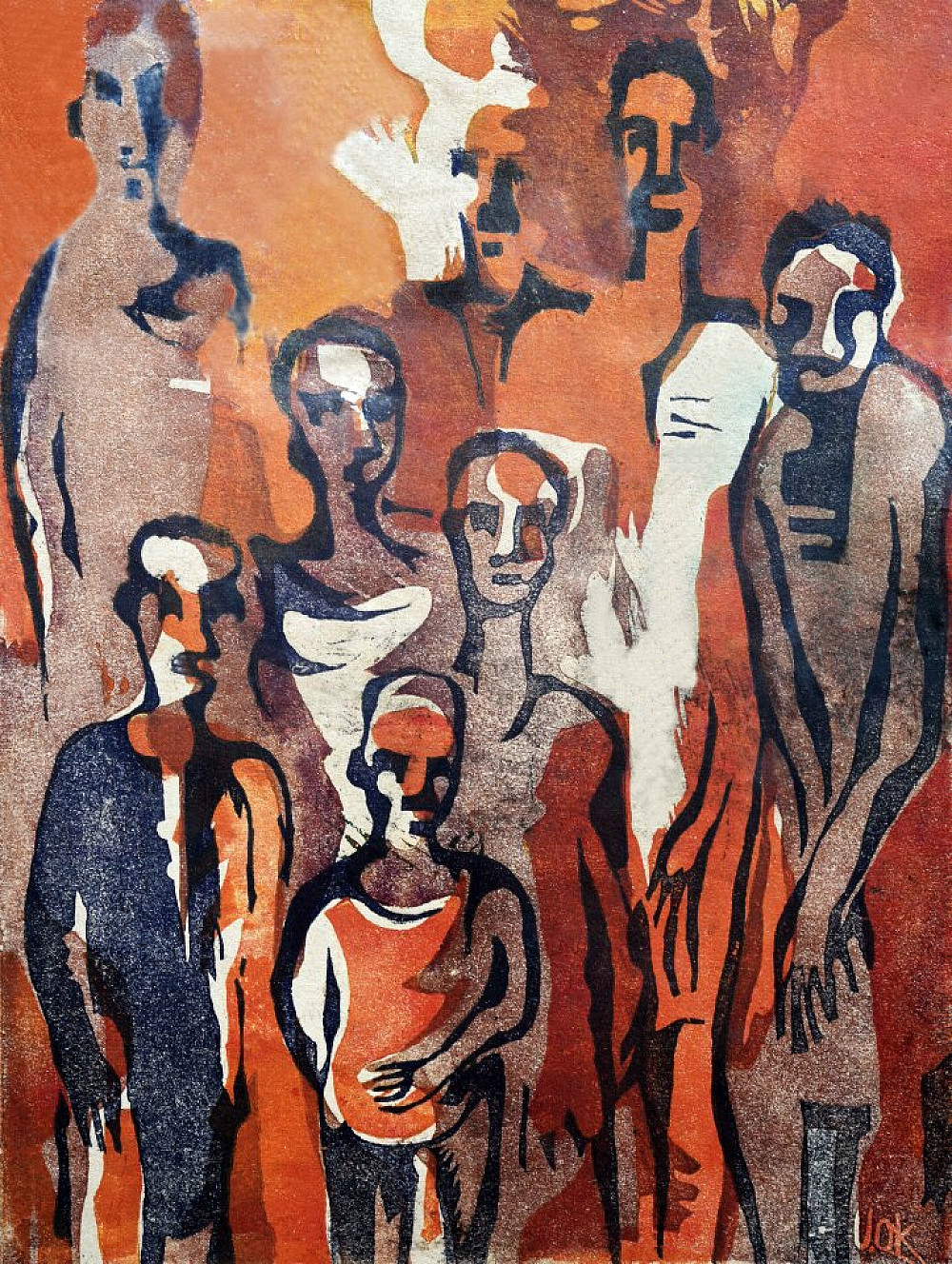
Artist Spotlight: Uche Okeke
Issue 01 - Articles
01 November 2025
Ayla Newton
Natural Synthesis in Practice


Uche Okeke, Title unknown, 1976, Painting (detail). © Uche Okeke Legacy (above)
Uche Okeke, Garden of Delight, 1982, Lino print (detail). © Uche Okeke Legacy (above)
Visually, it features a dominant warm orange field (suggestive of heat or light), with a large circular form in the upper left portion (the sun) and near the lower centre a small cluster of darker, more saturated tones (blues, greens, blacks) which may suggest landscape or abstract sign‑forms.
Garden of Delight depicts a lush and idyllic garden, symbolizing a place of pleasure, beauty, and tranquillity.


Uche Okeke, Bring with Ove (Early Birds Nimo), 1993, Painting (detail). © Uche Okeke Legacy
Uche Okeke, The Spirit Woman and Dibia, 1969, Etching (detail). © Uche Okeke Legacy
Uche Okeke coined the term Natural Synthesis to describe an approach that drew from Nigeria’s indigenous traditions - especially uli and nsibidi, while engaging modernist techniques and global dialogues. It was not a nostalgic return to the past, but a forward-looking philosophy: to carry cultural heritage into modern art, and to make African modernism as experimental and relevant as any global counterpart.
Okeke’s philosophy was grounded in the post-independence spirit of Nigeria. He believed artists had a responsibility to shape the cultural future of the nation. His work reflects this conviction: a synthesis of experimentation, cultural memory, and the living vitality of Igbo aesthetics.
“Young artists in a new nation, that is what we are!
We must grow with the new Nigeria and work to satisfy her traditional love for art or perish with our colonial past.”
- Uche Okeke