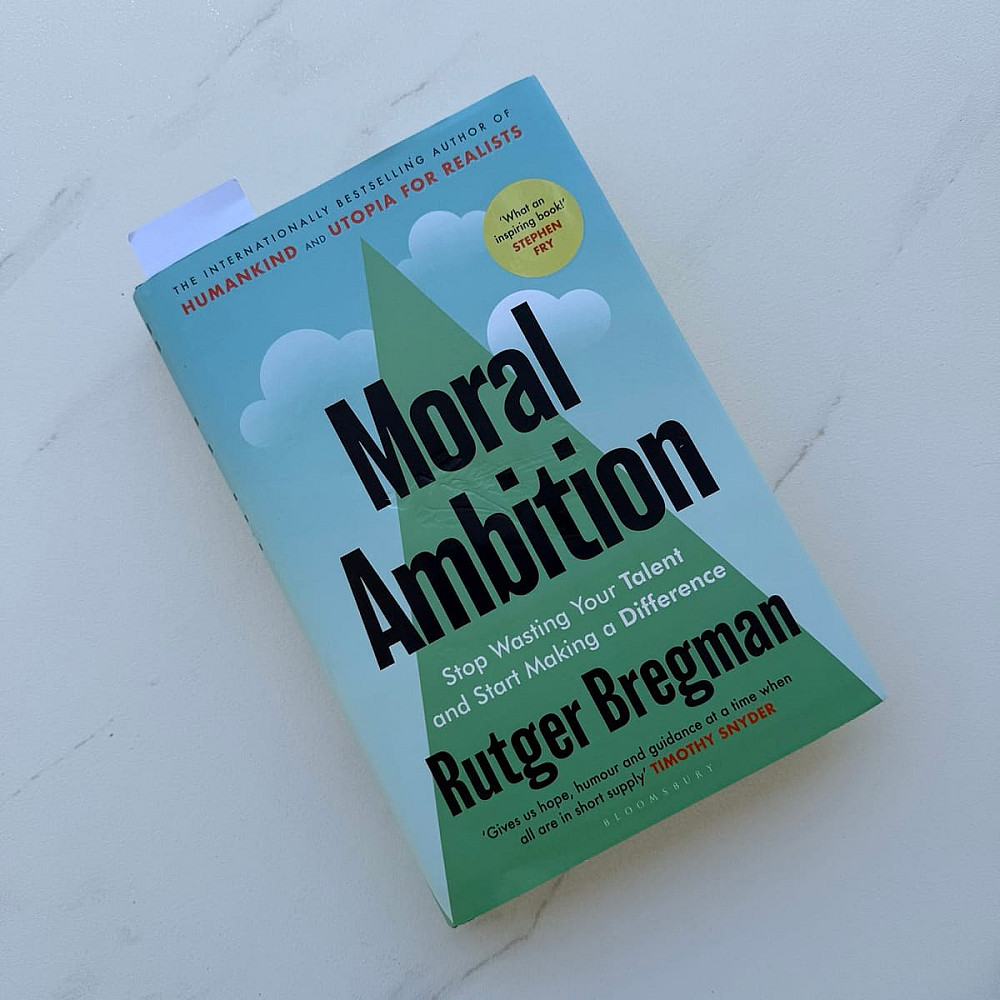
Book Review: Moral Ambition
Book Reviews
01 November 2025
Tamzin Lovell
“Ambition is not about getting ahead of others,
but about lifting others up.”
— Rutger Bregman, Moral Ambition
A friend recently recommended this book. She isn’t from the art world, and her recommendation was a personal one, but I found relevance across everything I do, and I think you might too. In Moral Ambition, Dutch historian Rutger Bregman - best known for Utopia for Realists and Humankind - turns his attention to a question that feels almost radical in its simplicity:
If you have talent, how do you use it well?
His argument is clear, and quietly subversive. In a world obsessed with career success and visibility, Bregman calls for a new kind of aspiration - one guided by conscience, not competition. He urges readers to shift their ambitions from personal achievement to collective impact, arguing that true progress comes when intelligence and privilege are redirected toward solving humanity’s most urgent problems.
It’s easy to read Moral Ambition as a book for politicians, scientists, or entrepreneurs.
But its argument lands squarely in the cultural field too. The art world, like every creative ecosystem, is full of talented people whose energy is often captured by systems of recognition rather than responsibility.
Bregman’s challenge - to “make doing good the new cool” - asks what moral ambition could look like in studios, museums, or design labs. Could curators measure success not by footfall, but by care? Could artists treat visibility not as self- promotion, but as service? Could institutions become moral infrastructures, not merely logistical ones?
Bregman’s optimism can feel disarming - he writes with the same faith in human nature that defined Humankind - but it’s underpinned by rigour. He draws on psychological research, moral philosophy, and everyday stories of people who chose integrity over prestige. His tone is not naïve but quietly insurgent: he believes most people want to help; they just need better maps.
For readers of ARMATURE, Moral Ambition resonates as both challenge and mirror. It reminds us that visibility, technology, and legacy - the pillars of this issue - are not neutral tools, but moral choices. The systems we build for art are not just technical frameworks; they are ethical ones.
At its heart, Bregman’s book argues for a culture in which ambition itself becomes moral: where creativity and power are measured by the good they enable, not the attention they attract. It’s a question worth carrying into every field - and perhaps, every issue of this magazine.
