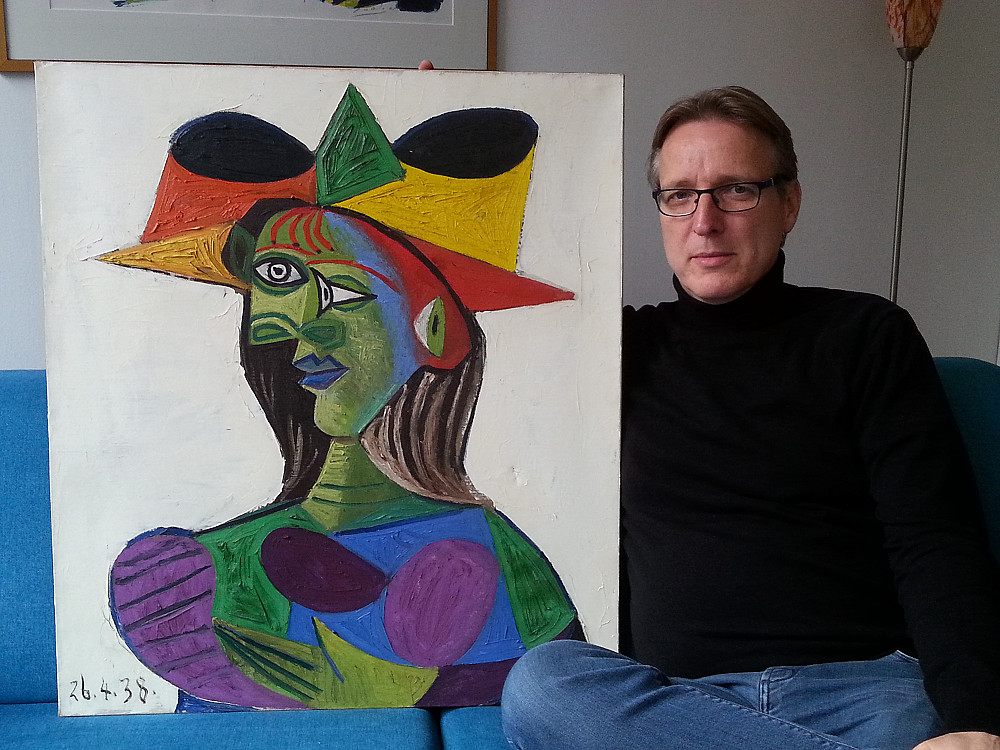
The Art Detective Who Wins by Keeping His Word
Issue 02 - Articles
04 March 2026
Werner Botha

“It’s one of the nicest jobs in the world,
but I would never do it again.”
- Arthur Brand
Book of Hafez
On a Saturday night, most people are off-duty. Arthur Brand can’t afford to be.
“If somebody calls me at 11 o’clock in the evening and says, ‘Mr. Brand, I’ve got some information for you,’ I can’t tell him, ‘Let’s do it tomorrow,’” he says, “because he might change his mind.”
Brand has spent more than two decades in the shadows of the art world - tracking stolen works, untangling forgery scandals, and negotiating the fragile human chain that connects museums, collectors, dealers, informants, and criminals. It’s a job built on patience, discretion, and an unusual kind of discipline: the willingness to treat everyone, especially the people you don’t agree with, as if they’re telling you the most important story of their life.
“It’s one of the nicest jobs in the world,” Brand says, “but I would never do it again.”
A childhood story about a man who fooled the Reich
Brand’s fascination with art crime began far from any glamorous auction room.
He grew up in a small town in the east of the Netherlands, where “your street is your entire world.” Then his grandfather started telling him stories about a local legend: Han van Meegeren, the Dutch painter who became a master forger.
Van Meegeren, as Brand recounts it, was the artist nobody liked - until he reinvented himself as a faker of “lost” Vermeers. The brilliance wasn’t just in the brushwork; it was in the psychology. Because art historians knew Vermeer had travelled to Italy and suspected paintings from that period were missing, the hunger for an “Italian Vermeer” was already there. Van Meegeren simply offered the world what it desperately wanted to find.
During World War II, he sold a fake Vermeer to Hermann Göring. After the war, the painting was discovered, and van Meegeren was arrested - apparently for selling Dutch cultural heritage to the Nazis. In court, he made a choice that turned his fate inside out. “I didn’t sell a real Vermeer to Göring,” he told the judge, “I faked one.” Nobody believed him, until he recreated a painting in front of officials and cameras.
For the young Brand, the story detonated the borders of his small-town imagination. Here was a world where art was power, deception, and high drama, and where one man could outsmart the most terrifying machinery in Europe with pigment and nerve.
His father, a history teacher, reinforced the pull by taking him to museums. And like many teenagers, Brand admits there was an extra ingredient: crime itself, the forbidden logic of it, the thrill of a hidden system running alongside polite society.
The night in Spain that changed everything
At 19, Brand went to Spain to study Spanish. One night, sitting on a balcony after drinks, he saw men loading a car in darkness - shovels, lights, the quiet intent of people who don’t want to be noticed.
He went over and asked what they were doing.
“Treasure hunting,” they told him.
He asked if he could go along.
They said yes.
Only later did he understand the full illegality of what he’d joined. But in that moment, out in the field with metal detectors, when the men uncovered Roman silver coins, time collapsed. “To have a coin in your hands that was buried for 2,000 years,” Brand says, “with the face of a Roman emperor… it was mind-blowing.”
Back home in the Netherlands, he began collecting ancient coins legally through dealers, until he encountered the other half of the story: fakes. “I don’t want to have forgeries in my collection,” he remembers thinking. “I want a Roman coin that’s really 2,000 years old, not made the other day.”

Visigoth Stones
The deeper he looked, the more disturbing it became. Forgery wasn’t a fringe problem; it was structural. Brand cites figures he encountered in his research - numbers so big they sound like exaggeration unless you’ve watched the market up close. Whether or not any single statistic holds, the larger point remains: in a world where authenticity is a story told by documents, experts, and reputation, deception scales easily.
An apprenticeship with a notorious insider
Brandt’s next step came through a website.
He found the work of Michel van Rijn, a Dutchman living in England who, Brand says, had been deeply involved in art crime for years before switching sides and becoming an informant. “A really strange guy,” Brand calls him.
Part villain, part whistleblower, unafraid to name names and burn bridges.
Brand emailed him encouragement. Van Rijn invited him to England. Over the next six years, Brand helped with the website and learned the craft the way it’s actually practiced: through network, rumour, and human weakness.
Van Rijn introduced him to police contacts across Europe, to journalists, and to people Brand calls “informants from the criminal underworld.” It was an education in how art moves when it can’t move openly.
And then, in 2009, Brand left. “I realized he was on the good side,” Brand says, “but if nobody looked, he was still a little bit on the bad side. So I decided I have to get out of here before it gets ugly.”
He started on his own.
"My solution sounds naïve: be honest."
- Arthur Brand
The job you never read about
The public version of an art detective’s life is cinematic: heists, recovery operations, dramatic handovers. Brand’s working reality is quieter, and financially, far more practical.
“One thing I do, which you never read about in the newspapers, and that’s where I make my money,” he says, “is advising collectors.”
A collector calls: I want to buy this Picasso. Is the price fair? Is it authentic? Has it been stolen? Was it looted in wartime? Could a claim surface later? Brand’s work here is risk management - due diligence in a market where reputations can be polished, paperwork can be “created,” and a single bad acquisition can become a lifetime headache.
The other half of his life is the work people assume is the whole job: tracking down stolen art and forgeries. Because there aren’t many specialists who do both, and because his network is deep, he’s become a go-to figure, often working alongside law enforcement.
“I am a civilian,” Brand says, “so I always coordinate… with a prosecutor or the police.” Even when he’s not legally required to, he wants them to know what he’s doing. In many countries, he notes, there may be only one officer dedicated to art theft, and that officer may be juggling a caseload spanning continents.
How stolen art really travels
People imagine stolen paintings disappearing into the private lairs of cartoonish billionaires - the “Dr. No” fantasy Brand laughs about. In reality, the problem isn’t finding someone rich enough; it’s finding someone reckless enough.
“Nobody wants to touch a stolen painting,” Brand says.
So the work doesn’t vanish into a secret gallery. It moves sideways, into the underworld economy.
A stolen painting becomes collateral. A drug deal comes up short; a canvas stands in for cash. The painting changes hands not because anyone wants to live with it, but because nobody wants to lose face in a deal.
Over time, the object drifts from one group to another, sometimes for years, until it ends up in the possession of someone who didn’t steal it, can’t sell it, and doesn’t know how to get rid of it.
Then Brand’s phone rings.
Getting to that point is its own maze: criminals aren’t in the phone book, and the first outreach is often a test. Brand describes calling a suspect and naming the rumour plainly. The typical response is a fast hang-up - too fast, he suggests, to be innocent outrage. A few days later, the same person calls back: Let’s talk.
These conversations, Brand says, are not about moral lectures. They are about making the painting feel like a liability again, because that’s when people start thinking clearly.
“You get a whole police investigation on your back,” Brand tells them, “and I know you are dealing in drugs… I’m not certain that’s a good idea for you, because of this stupid painting.”
He calls it the Al Capone principle: if they can’t catch you for the big thing, they may catch you for something else. The stolen artwork becomes a thread nobody wants pulled.
Trust, in the world where nobody trusts anyone
Brand’s most valuable tool isn’t a database or a lab. It’s trust - and it’s earned in a place where trust is constantly weaponised.
When he was younger, watching van Rijn with informants, Brand noticed a pattern: each side assumed the other would double-cross, so each side prepared to strike first. It’s a spiral that turns every exchange into a trap.
His solution sounds almost naïve: be honest.
“It’s that simple,” he says. “Keep your word.”
Brand runs his work on two rules:
1. Obey the law.
Because he works closely with police and prosecutors, and appears publicly in documentaries, he can’t afford shortcuts that endanger cases or embarrass institutions.
2. Keep your word.
Informants are often scared their names will surface. Sometimes they’re not criminals at all: a neighbour, a family member, a dealer who heard something. Sometimes they are criminals, offering information about a rival. Brand’s posture is consistent: don’t judge; don’t grandstand; protect the source.
“Sometimes somebody calls me telling, ‘I have this secret for 30 years,’” he says. “You don’t have to judge them.”
The irony is that decency becomes a tactical advantage. If you treat people well in a world where everyone expects exploitation, you become memorable, and people call you back.
The recoveries you’ll never hear about
Not every success becomes a headline. Brand says a significant portion of recoveries stay out of the press at the request of museums, collectors, or other parties who want the matter resolved quietly. The reasons vary: reputation, legal exposure, fear of copycat theft, or simply the desire to end a nightmare without inviting a second one.
That’s frustrating for storytellers - the best cases are often the ones you can’t tell. But Brand points to a deeper consequence: public perception of art crime becomes distorted. We imagine spectacular heists; we overlook the slow disappearances, the quiet laundering of objects into respectability, the years-long limbo in which an artwork becomes a problem passed from hand to hand.
Sometimes, he says, discretion has an unexpected payoff. In one case, after a painting was returned through a careful, prosecutor-approved process, the person who held it later contacted Brand with intelligence about a planned armed robbery at a major European museum. The warning helped authorities intervene before the theft occurred.
“That would have been maybe the theft of the century,” Brand says.
What’s changing now
When Brand looks at the last decade, he sees art crime shifting in response to both policing and market demand.
Art as leverage.
Some criminals acquire stolen art not to sell it, but to use it later as a bargaining chip - an “insurance policy” if they’re arrested for other crimes. The idea is simple: I’ll give you something valuable; you give me fewer years. Brandt notes that different countries handle such arrangements differently, and miscalculations can be costly.

The cost of a life on call
Brand’s mother wanted him to choose a normal job: home at five, the door closed, the world held at bay. Brand wanted adventure. He got it - along with insomnia, endless waiting, and a life that’s never really “off.”
“It’s 24/7,” he says. “There’s no time for other hobbies.”
Some cases take a decade. Many fail. And even success can be complicated by the very secrecy that makes recovery possible. The work sharpens a person, into vigilance, patience, and restraint, but it also narrows a life.
Still, he keeps going. Not because he believes art crime can be eliminated - he doesn’t. “On Monday, art was invented,” he jokes. “On Tuesday, the first art was stolen. And on Wednesday, the first art was forged.”
He keeps going because every returned object is a repaired link: between a culture and its history, between a family and what was taken, between a museum and the public trust it relies on. And because, in a world built on deception, one of the rarest commodities is still a person whose promises hold.

Ring of Oscar Wilde
"In a world structured by deception, the rarest commodity
may still be a person whose promises hold"
- Arthur Brand