The Metadata of Meaning
Issue 01 - Articles
01 November 2025
Werner Botha
The Hidden Frame of Every Image
Every digital artwork, every photograph, every scan you’ve ever uploaded carries a shadow text. A quiet scaffolding of data that determines how, where, and whether it’s ever seen. This hidden layer is metadata: the titles, descriptions, keywords, creator fields, and file properties that travel with an image across the internet. Before digital databases, art records lived in ledgers, filing cabinets, and index cards. The transition to digital catalogues promised access and preservation – but also created a new dependence on data points being created for every reference.
Metadata is not glamorous. It’s rarely discussed at openings or panel talks. Art in the digital attention age has its visibility and survival impacted by this invisible infrastructure. In museums, galleries, and online archives, metadata is the DNA of its discovery.
The Hidden Infrastructure of Art
That tells search engines and catalogues what a work is, who made it, when, and how. It links a single object to networks of context to a movement, a region, a medium, and a story. When metadata is wrong or missing, that work might as well be invisible or worthless.

Shubham Dhage
“Metadata
is the infrastructure
of meaning.”
Today, metadata systems determine what rises to the surface and what disappears.
In major institutions, digital departments spend as much time describing art as preserving it. The fields they fill such as, Title, Creator, Medium, Date, Provenance, Subject or Rights, form the language through which the art world now “reads” itself.
“No approach to archival description, no descriptive system or architecture, can escape the reality that it is a way of constructing knowledge through processes of inscription, mediation, and narration.” — Wendy M. Duff, Professor & former Dean, Faculty of Information, University of Toronto; and Verne Harris, former Head, Memory Programme, Nelson Mandela Foundation, 2018 “Metadata is a love note to the future.” — Jason Scott, Archivist & Curator, Internet Archive, 2015
A photograph labelled “Abstract Painting” will surface in different contexts than one tagged “African Modernism” or “Uli-inspired drawing”. The choice of words is the metadata. It shapes the historical narrative itself as well as the artwork's future.

Who Writes the Record?
If metadata is meaning, then authorship of that data becomes a matter of power. For much of art history, cataloguing reflected colonial and Eurocentric frameworks: African sculptures were tagged as “primitive art”, women artists were recorded as “assistants”, or modernists from the Global South were omitted entirely from metadata networks that feed institutional databases.
Even in the digital present, bias persists. Search engines reward familiar terms and English-language tags, marginalising works catalogued with indigenous, local, or non-Western descriptors. Metadata isn’t neutral – it encodes perspective, hierarchy, and sometimes, historical prejudice.
Correcting that record is an act of cultural repair.
Richard Horvath
When the Uche Okeke Legacy Foundation began digitising the artist’s archive, each tag became a curatorial decision. Should his work be listed under modernism, African modernism, or postcolonial modernism? Should Uli, the Igbo decorative practice that shaped his line, be entered as “folk art” or “philosophical framework”? “Archives have never been neutral, they are the creation of human beings, who have politics in their nature.” - Jarrett M. Drake, archivist and scholar, February 15, 2017
When Machines Learn Meaning
Generative AI models like DALL·E, Stable Diffusion or Midjourney don’t just learn from images; they learn from metadata. When they scrape the open web, they collect not just pixels but words: the alt-text, captions, and keywords attached to those images.
A painting tagged “female artist, oil, 1960s” doesn’t just inform a dataset; it teaches a machine what those words mean together. Metadata becomes instruction, a vocabulary of aesthetics.
That makes accurate metadata an ethical issue. The more mislabelled or context-stripped data circulates, the more machines replicate distorted versions of art history.
If a generation of AI models trains on incomplete or biased metadata, they don’t just reproduce style, they reproduce hierarchy.
How to Do Metadata Right (for Artwork Images)
Metadata may feel like an administrative task, but it’s now a creative, ethical, and curatorial one. Doing it right means balancing visibility with integrity.
Here’s a practical, field-tested approach for artists, curators, and institutions to ensure artwork metadata protects both authorship and meaning:

Luke Jones, A close up of a blue eyeball in the dark 2024
1. Start with the Basics – Use Core Fields Consistently
Use the standard IPTC/Dublin Core metadata fields that travel across platforms.
Minimum essential fields:
2. Add Descriptive Metadata Thoughtfully
Descriptive tags and captions shape interpretation. Use culturally accurate, inclusive, and specific language. Example:
Think like a curator, not an algorithm. Describe the meaning, not just the object.

Dim Gunger, a colorful background with lines and curves, 2021
3. Include Contextual & Provenance Data
Metadata isn’t only about the artwork itself; it’s about lineage. Add exhibition history, acquisition notes, and previous owners where relevant. This information builds trust and helps historians, collectors, and AI systems trace provenance accurately.
5. Protect Against AI Scraping
Add robots.txt or noAI metadata tags to your website to signal that your images should not be used for AI training. You can also include a visible or invisible watermark with creator and copyright data. Ethical visibility means being seen by people, not exploited by systems.
4. Embed, Don’t Just Upload
Always embed metadata into the image file itself (using Adobe Bridge, Lightroom, or similar tools). Uploading captions or tags separately (as in Instagram posts) doesn’t protect the image if it’s downloaded or scraped. Embedded metadata travels with the file wherever it goes.
6. Keep a Metadata Master File
Store a CSV or spreadsheet of all your image metadata - titles, dimensions, filenames, and rights. This serves as a digital catalogue raisonné and a record of intellectual property.
How to Do Metadata Right (for Artwork Images)
As archives expand and images circulate, metadata becomes both mirror and map. It reflects what the art world values and shapes what the world learns. Correcting it, rewriting it, and embedding it with care are acts of authorship.
“There is no representation without intention and interpretation. Description tells a story.” -Wendy M. Duff, Professor (and former Dean), Faculty of Information, University of Toronto; and Verne Harris, senior archival leader, Nelson Mandela Foundation, 2002.
Treating metadata not as paperwork but as practice allows us to rebuild the infrastructures of visibility. These systems honour artists’ intentions, preserve their contexts, and tell the truth in the smallest details.
In the end, metadata is how memory travels. The future becomes less like a flux and a blur but educated estimates. Owners, investors and stakeholders no longer hope someone remembers but rely on the systems that do. In this digital age, memory is everything.

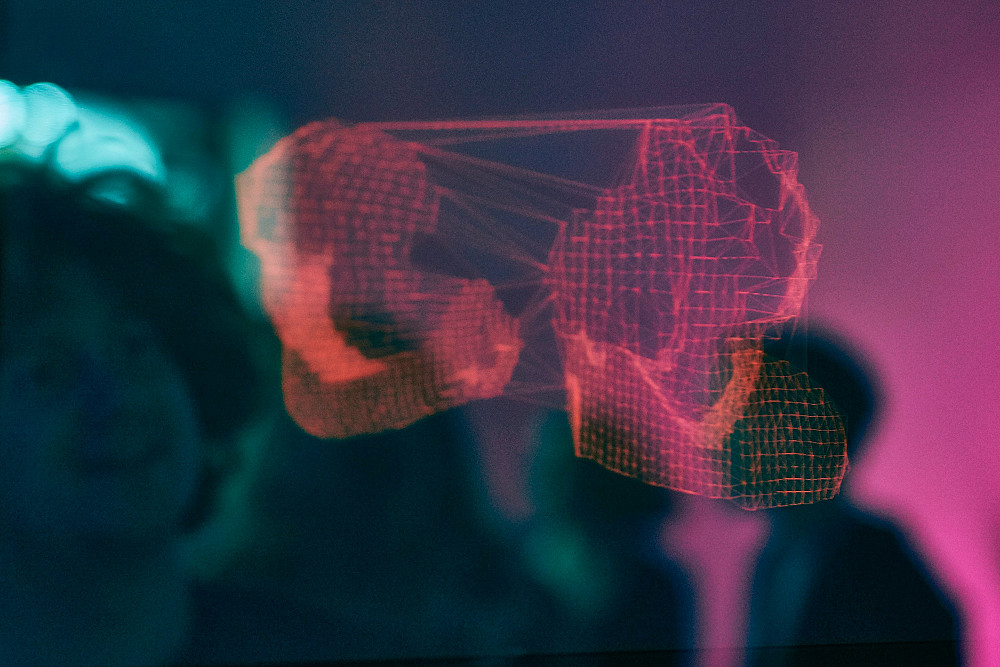
Ashwin Vaswani, man loking at hologram, 2018