The Systems of Disappearance
Issue 02 - Articles
04 March 2026
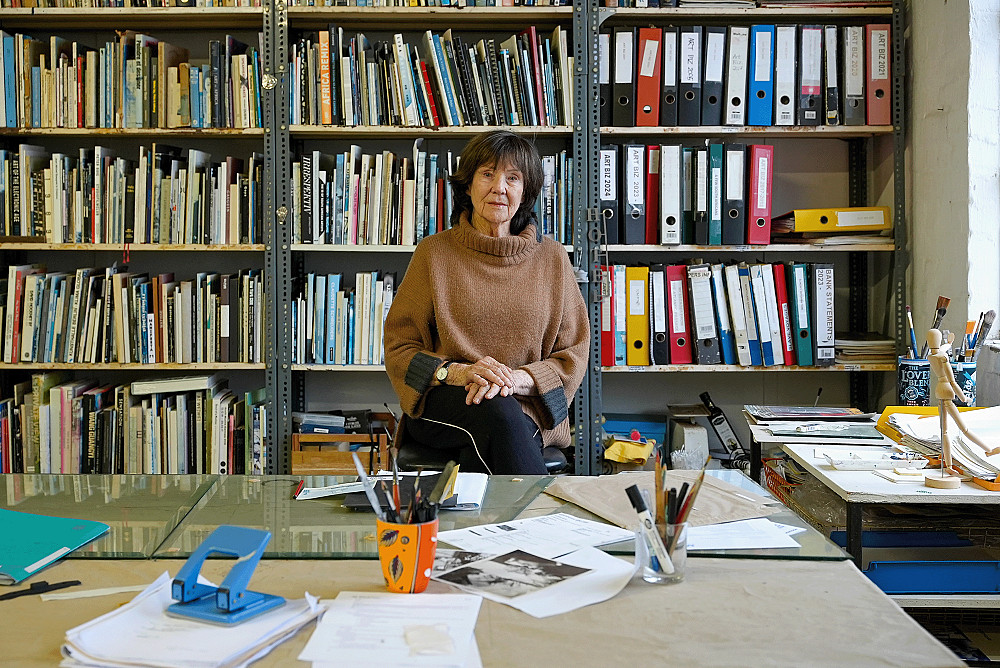
Sue Williamson
Memory is often imagined as something we preserve, a kind of storehouse of facts rescued from erosion. In Sue Williamson’s work, memory is less stable than that. It slips. It thins. It depends on evidence that may not survive.
Williamson does not try to halt disappearance. She studies how it operates.
Across five decades, her practice has traced memory through bureaucratic documents, domestic fragments, testimony, and, more recently, the natural environment. Through installations, resin-bound fragments, and reconstructions, she builds provisional structures that reveal how memory depends on material conditions.
Evidence that dissipates

A Few South Africans: Amina Cachalia, 1984. Photo etching/screen print collage

A Few South Africans: Mirium Makeba, 1987. Photo etching and screen print collage
In her interview for this issue, Williamson described her work as engaging with “dissipating evidence” - traces that erode over time. When asked how she decides whether a fragment is still strong enough to carry a story, she responded:
“This depends entirely on the nature of the fragment, and how clearly the context can be conveyed to the viewer.”
Meaning is not inherent. It is constructed.
A chipped piece of plaster or scrap of plastic from District Six can carry weight - once held in resin, placed on a shelf, accompanied by a small note of origin. These gestures do not explain the fragment; they frame it.
“My work doesn’t answer questions. Rather, it raises questions the viewer might wish to consider.”
Williamson is not reconstructing history. She is reconstructing the conditions under which history can be questioned.
The Last Supper: documenting absence
The Last Supper begins with an eviction notice delivered to the Ebrahim family in District Six. On the day it arrived, Naz Ebrahim wrote “Welcome to The Last Supper” in green Koki on her hallway wall, turning the house itself into a document of removal.
When Williamson visited, she signed the wall as witness.
The later installation, bringing the family’s dining chairs into the gallery, did not attempt to recreate the house. The chairs stand in for bodies without replacing them. They register absence without resolving it.
The power of the work lies not in symbolism, but in restraint. The objects remain ordinary. Their charge comes from context.
Preservation as reframing
Years later, when District Six had been razed, Williamson returned to find only fragments embedded in soil. She collected debris and encased it in resin in the series Museum Cases. These were not relics. They were remains.
Does preservation alter meaning?
“Preservation doesn’t change meaning… but by giving it context, a small layer of meaning is added.”
Preservation, in her hands, is reframing. A shard of china becomes visible not because it is rare, but because it survived.
She does not romanticise fragments. She traces how systems allow forgetting, and how fragile structures allow something to surface again.
When the ground becomes the archive
In 2025, Williamson revisited District Six with Idrissa, Naz’s daughter. After decades, the material evidence had blurred. It was no longer possible to tell whether a brick just below the surface belonged to the original houses or had been dumped later.

Museum Case #9, Nile Street, 1993 and 2023. Found objects in casting and polyurethane resin in wood and perspex case. Phot credit: Matt Slater
The chain of custody had dissolved.
Her response is to shift medium. Instead of objects, she plans to work with grasses and wild plants now growing across the erased streets, pressed and mapped onto former grids.
This is not sentimentality, but adaptation.
When buildings disappear and fragments lose clarity, the landscape becomes the archive.
Her trajectory is precise:
Full-scale materials - chairs, doors, domestic remains.
Sub-surface fragments - shards, plaster, debris.
Botanical traces - grasses rooted in absence.
At each stage, less remains. The work adjusts accordingly.
Bureaucracy and control
Williamson’s engagement with passbooks, shipping records, and identification documents exposes another system - one built to control rather than preserve.
“Who wrote this? What is the intended function? Who is the audience?”
Under apartheid, bureaucratic documents enforced instability. They were not neutral records; they produced vulnerability.
By reframing these documents as art, Williamson reveals their violence. Administrative language becomes evidence against itself.

Writing on the wall of Naz Ebrahim's home Manley Villa, District Six
Art as counter-record
Williamson resists the idea that she is a custodian of stories.
“I am not trying to fill in the gap between institutional and lived memory… simply putting forward a documentation mediated through my own way of making art.”
The statement is modest, but its implications are not.
Works such as The Last Supper and Messages from the Atlantic Passage operate less as explanations than as environments. They allow viewers to experience the mechanisms of disappearance without offering resolution.
In an era of digitised archives and endlessly reproducible images, her insistence on material evidence feels deliberate.
“I fear for a history constantly being revised by AI… the feeling of authenticity has been lost.”
Her work returns us to matter, to weight, surface, residue.
What remains
Williamson does not mourn loss so much as examine it.
Evidence decays.
Documents mislead.
Landscapes overwrite.
Her practice is patient, forensic, careful not to claim authority over what cannot be fully known.
If this issue considers how systems hold (digitally, architecturally, logistically), Williamson turns to a more precarious question: what holds memory itself?
What happens when the archive is incomplete?
When documents were designed to deceive?
When rubble erodes into soil?
Her answer is not to restore what is gone. It is to read what remains.
In her work, disappearance is not an ending. It is a condition.
And the work of memory begins there.
"Preservation doesn't change meaning... but by giving it context,
a small layer of meaning is added."
- Sue Williamson
