The Unreliable Archive
Issue 02 - Articles
04 March 2026
Hermione Allsopp
The Material Memory of Domestic Life
Memory does not only live in institutions. It lives in the things we keep. The sofa that has absorbed years of arguments and naps. The chair inherited from someone no longer alive. The ornament that once felt elegant and now feels faintly embarrassing.
These objects form an early education in trust. They sit quietly in the background of our lives, holding continuity without announcing it.
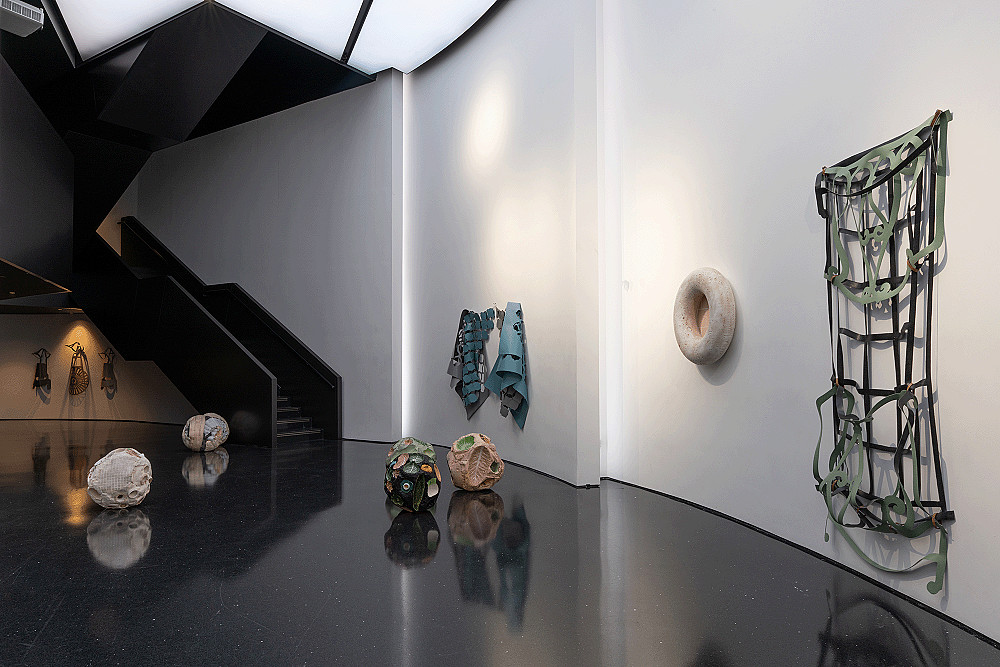
For British artist Hermione Allsopp, these objects are unstable containers. Her sculptures transform household materials into forms that feel both familiar and wrong. Chairs buckle. Tables sag. Plastic melts into dense, geological masses. Upholstery becomes topography.
Recognition and estrangement sit side by side.
If institutions hold collective memory, Allsopp asks a different question: what holds personal memory? And what happens when we alter the objects that once held it for us?

"These objects form the first architecture of trust we ever encounter."
- Hermione Allsop
Unexpected Consequence. Image Sergey Novikov
The material life of memory
There is tension in Allsopp’s work between use and undoing. A chair collapses inward. A bookshelf slumps as if exhausted. A mound of fused ornaments and crockery reads like a bright sediment of home.
These objects do not behave as they should.
Her process of melting, compressing, slicing, binding, exposes the emotional residue embedded in materials without drifting into nostalgia. She works with things that have been handled, sat on, decorated rooms, lives.
“I work with things that have been used”.
“They carry stories, histories, relationships. But I’m not trying to preserve them. I’m trying to see what they become.”
Memory, here, is not a fixed archive. It is something that shifts as the material shifts.
Trust and estrangement
The unease in Allsopp’s work comes from recognition. We know these objects. We have owned them. Trusted them to remain solid.
In her sculptures, that stability gives way.
What we assumed was dependable reveals its flexibility.
The effect is surprisingly quiet. A small recalibration of how much faith we place in the everyday.
The domestic as archive
While Sue Williamson examines formal cultural archives, Allsopp stays at home.
The domestic interior functions as an informal archive. It stores memory without cataloguing it. Scratches, stains, dents - these are not metadata, but traces of use.
Objects outlive relationships. They survive versions of ourselves we would rather forget. They accumulate meaning unevenly.
In Allsopp’s hands, the domestic archive slumps. A chair no longer supports. An object becomes sculpture, and biography loosens.
The work does not mock memory but rather exposes its instability.
Material agency
One of the more compelling aspects of her practice is the sense that materials have their own momentum. Foam expands. Wood warps. Plastic slumps under heat.
Allsopp does not fully impose form. She negotiates with it.
This shifts memory away from something controlled solely by the mind. Memory becomes a dialogue between hand and material. Between intention and reaction.
Objects do not simply obey. They respond.
That responsiveness mirrors how remembering works: selective, partial, reshaped over time.
"Domestic objects are unreliable narrators."
- Hermione Allsop

Highly Sprung exhibition

Unexpected Consequence. Image Sergey Novikov
Failure and reconstruction
Her sculptures often feel improvised, poised somewhere between accident and decision. A warped shelf is both ruin and reconfiguration. A broken object becomes something newly legible.
There is no attempt to restore an original state. Instead, she allows deformation to generate meaning.
Forgetting sits alongside remembering. Distortion sits alongside truth.
The work acknowledges that continuity is rarely clean.
In conversation with Sue Williamson
Within this issue, Allsopp and Sue Williamson explore different aspects of trust.
Williamson examines political erasure and institutional absence. Her work deals with testimony, documentation, and systems of control.
Allsopp remains closer to the body and the home. She works with furniture and household objects.
Together, they stretch the idea of memory across registers - public and private, institutional and domestic.
Both resist the idea of memory as stable.
"They carry stories, histories, relationships.
But I'm not trying to preserve them. I'm trying to see what they become."
- Hermione Allsop
What remains
Allsopp’s sculptures suggest that the first archive is not a museum, but a room. And that the first experience of trust is not institutional, but tactile - the reliability of a chair, the weight of a table, the presence of a bed.
When those objects shift, melt, or buckle, something in our sense of continuity shifts with them.
In an era preoccupied with perfect digital records, Allsopp reminds us that memory has always been material, and that materials change.
The domestic archive is unreliable.
That may be its truth.


Sofulation
Oak Veneer Imposter III